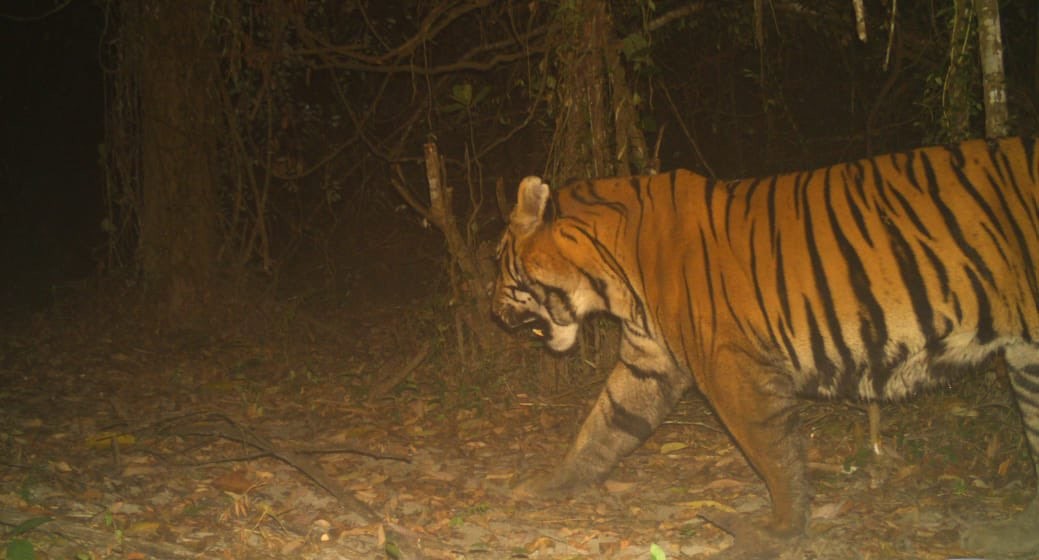
Staff Reporter, Tinsukia, January 21 : In the hushed floodplains of Dibru–Saikhowa, where riverine grasses sway and forests breathe in quiet rhythms, a long-absent ruler has returned. After nearly three decades of silence, the unmistakable stripes of the Royal Bengal Tiger have been captured on camera inside Dibru–Saikhowa National Park, rekindling memories of a time when the big cat roamed these wetlands with ease.
The rare images, recorded by camera traps jointly installed by park authorities and the Wildlife Trust of India, were taken at Shalibari Mukh near the Kundaghat forest camp under the Guijan Range of the Tinsukia Wildlife Division. For forest officials and conservationists, the photographs are more than just visuals — they are proof, promise and possibility rolled into one. Assam’s Forest Minister Chandra Mohan Patowary shared the moment with the world on Tuesday through his X handle, calling the sighting a milestone for the national park.
Behind the announcement lies months of meticulous effort: as many as 65 camera traps were deployed across the Guijan and Saikhowa ranges to monitor wildlife movement in the fragile ecosystem. The tiger was first photographed on December 14 last year and reappeared before the lens on January 1 — a symbolic start to 2026 that strengthened hopes of the species’ sustained presence.
Over the years, occasional claims of tiger sightings had surfaced from Dibru–Saikhowa, but none were backed by photographic evidence. Until now. The return carries deep historical resonance. Before Dibru–Saikhowa was notified as a national park, tiger censuses told a different story. In 1993, the area recorded a healthy population of eight male tigers, twelve females and seven cubs. A 1997 survey showed even stronger numbers. Then, abruptly, the records fell silent, and the tiger seemed to fade into memory.
That silence has finally been broken.The camera-trapped images have revived hope that Dibru–Saikhowa’s complex mosaic of wetlands, grasslands and forests can once again support the apex predator. More importantly, the sighting underscores the value of sustained conservation efforts in one of Assam’s most ecologically significant landscapes.
As the Brahmaputra’s channels continue to shape and reshape the land, the tiger’s quiet return serves as a reminder: when nature is given space and time, it remembers how to heal — and sometimes, it brings its most magnificent guardians back home.