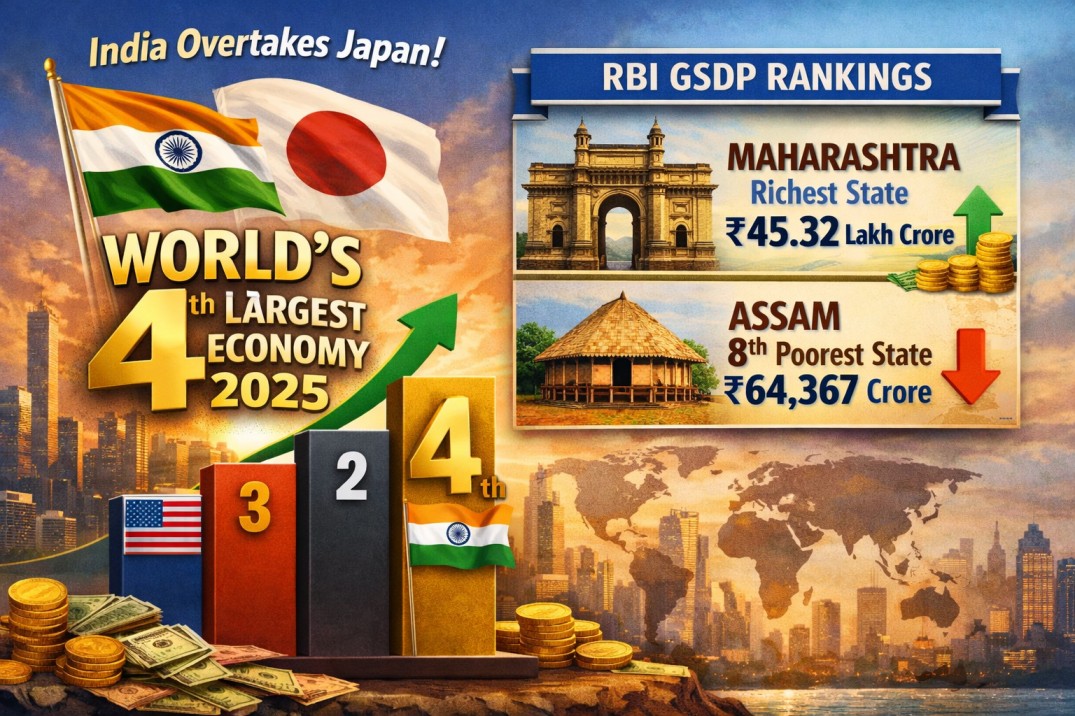
India’s economy continues its upward trajectory as the country has officially surpassed Japan to become the world’s fourth-largest economy in nominal GDP terms, with Maharashtra maintaining its dominance as the top state economy and Assam ranking eighth among the poorest states based on Gross State Domestic Product (GSDP) for FY 2024-25. Recent data from the Reserve Bank of India (RBI) highlights stark regional disparities amid India’s impressive national growth.
India Becomes World’s Fourth Largest Economy in 2025: Maharashtra Tops Richest States List While Assam Ranks 8th Among Poorest – Full RBI GSDP Rankings Revealed
India’s remarkable economic ascent has reached a historic milestone in 2025. According to official government reviews and international projections, the nation has overtaken Japan to claim the position of the world’s fourth largest economy in nominal terms, with its GDP valued at approximately $4.18 trillion. This achievement underscores India’s sustained high growth trajectory, driven by strong domestic demand, infrastructure investments, reforms, and a resilient services and manufacturing sector.
The government’s end-of-year economic review, along with statements from key institutions, confirms this shift. India’s nominal GDP has edged past Japan’s, positioning the country behind only the United States, China, and Germany in global rankings. Projections indicate that, if current trends persist, India could displace Germany to become the third-largest economy within the next 2.5 to 3 years, potentially reaching $7.3 trillion by 2030.
This global milestone is complemented by robust domestic growth forecasts. The Ministry of Finance estimates a 7.4% GDP expansion for the current financial year (FY 2024-25), up from 6.5% the previous year. The International Monetary Fund (IMF) has revised its outlook upward to 7.3% for 2026, while the Reserve Bank of India (RBI) anticipates similar momentum. These figures reflect a “Goldilocks” phase for the Indian economy—characterized by high growth, controlled inflation, and stable macroeconomic indicators.
RBI’s Latest Data on State Economies: Richest and Poorest States in FY 2025
While India’s national economy surges ahead, the RBI’s Handbook of Statistics on Indian States (2024-25 edition, released in December 2025) paints a nuanced picture of internal disparities. The data, based on Gross State Domestic Product (GSDP) at current prices for FY 2024-25, reveals significant inequality among states. Maharashtra continues to dominate as India’s largest state economy, while northeastern and smaller states lag behind, highlighting the urgent need for inclusive growth.
Top Richest States in India by GSDP (FY 2024-25)
Maharashtra leads unequivocally, benefiting from its position as the financial hub (Mumbai), strong industrial base, services sector, and entertainment industry. The state’s GSDP stands at ₹45.32 lakh crore, contributing substantially to national output.
- Maharashtra — ₹45.32 lakh crore
- Home to India’s financial capital, major ports, IT hubs, and manufacturing zones.
- Tamil Nadu — ₹31.19 lakh crore
- Driven by automotive, electronics, textiles, and a thriving IT sector in Chennai.
- Uttar Pradesh — ₹29.78 lakh crore
- Rapid infrastructure development, agriculture, and emerging industrial corridors have propelled this populous state forward.
- Karnataka — ₹28.84 lakh crore
- Bengaluru’s tech ecosystem, aerospace, and biotech sectors fuel growth.
- West Bengal — ₹18.15 lakh crore
- Strong in agriculture, manufacturing, and services.
- Rajasthan — ₹17.04 lakh crore
- Mining, tourism, and renewable energy play key roles.
- Telangana — ₹16.41 lakh crore
- Hyderabad’s pharma and IT dominance.
- Andhra Pradesh — ₹15.93 lakh crore
- Ports, agriculture, and industrial investments.
- Madhya Pradesh — ₹15.03 lakh crore
- Agriculture, mining, and infrastructure push.
- Delhi (UT) — ₹12.15 lakh crore
- National capital’s services and trade hub.
These top states and union territories form the backbone of India’s economic strength, accounting for a large share of national GDP through diversified sectors like manufacturing, IT, finance, and agriculture.
Poorest States in India by GSDP: Bottom Rankings (FY 2024-25)
At the other end, smaller northeastern states and certain hilly or resource-constrained regions feature prominently among the lowest GSDP figures. These states often rely heavily on agriculture, tourism, and central transfers, with limited industrial or large-scale infrastructure development.
- Arunachal Pradesh — ₹4,423 crore
- Small population, remote terrain, and limited industrialization.
- Tripura — ₹8,968 crore
- Agriculture and natural gas, but constrained by geography.
- Himachal Pradesh — ₹23,169 crore
- Tourism and hydropower dominant.
- Jammu & Kashmir — ₹26,246 crore
- Affected by regional challenges, agriculture, and tourism.
- Uttarakhand — ₹37,824 crore (approx., based on trends)
- Tourism and emerging industries.
- Jharkhand — ₹51,626 crore
- Mineral-rich but faces development hurdles.
- Chhattisgarh — ₹56,788 crore
- Mining and agriculture.
- Assam — ₹64,367 crore
- Tea, oil, and agriculture form the core, yet overall scale remains modest despite recent growth momentum.
- Punjab — ₹83,864 crore
- Agriculture powerhouse facing structural issues.
- Odisha — ₹89,004 crore
- Mining and emerging ports.
Assam, despite showing one of the fastest growth rates among major states in recent years (around 45% expansion at constant prices over five years in some analyses), ranks eighth in the lowest GSDP list due to its absolute size. The state’s economy is anchored in tea plantations, oil and natural gas, handlooms, and agriculture, but it grapples with infrastructure gaps, flood vulnerabilities, and limited large-scale manufacturing.
Economic Disparities and the Path Forward
The contrast between the richest and poorest states underscores persistent regional inequalities in India. While southern and western states benefit from urbanization, education, and private investment, northeastern and certain central/eastern states face geographical, infrastructural, and historical challenges.
To bridge this gap, experts emphasize:
- Increased central and private investment in the Northeast, including improved connectivity via roads, railways, and airports.
- Focus on industrial corridors, skill development, and agro-processing industries.
- Leveraging natural resources sustainably while boosting tourism and hydropower.
- Policy reforms for inclusive growth, such as enhanced central transfers and targeted schemes.
India’s rise to the world’s fourth largest economy is a collective achievement, but true progress requires equitable distribution of prosperity. As the nation eyes the third spot globally, addressing state-level disparities will be crucial for sustainable and inclusive development.
This analysis draws from the RBI’s Handbook of Statistics on Indian States 2024-25, government economic reviews, IMF projections, and related reports, providing a comprehensive view of India’s economic landscape in 2025.