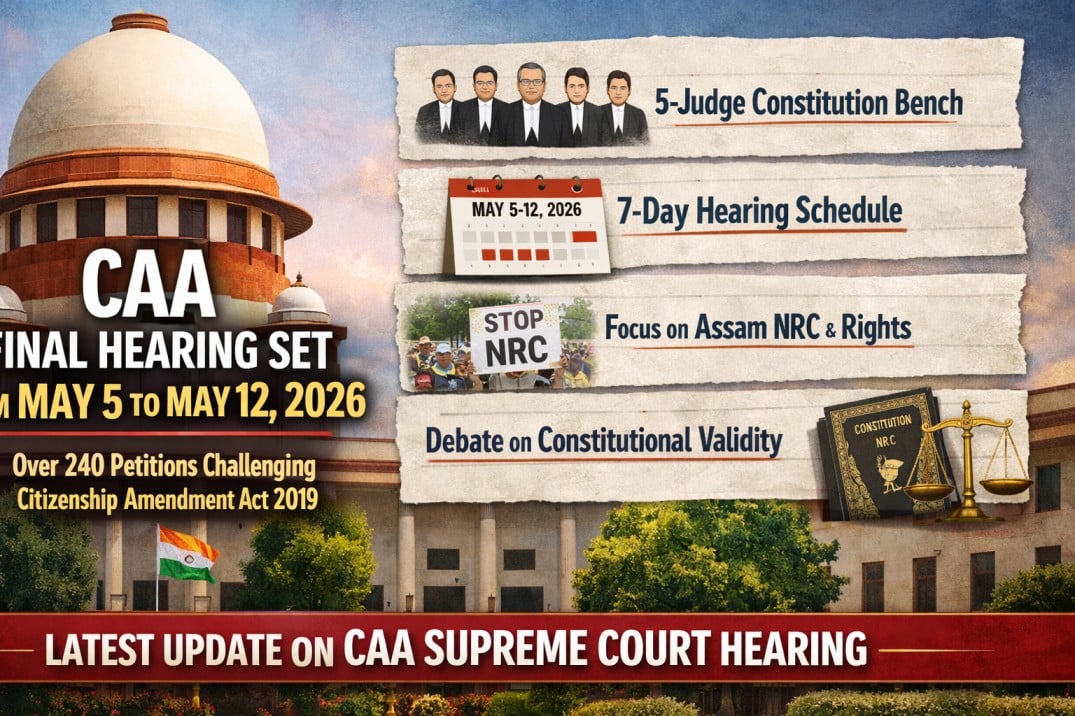
Supreme Court Schedules Landmark Final Hearing on CAA Challenges from May 5, 2026: Over 240 Petitions to Be Decided After Years of Delay
New Delhi, February 20, 2026 — In a significant development that could resolve one of India’s most contentious legal and political battles, the Supreme Court on Thursday (February 19, 2026) announced that the final hearing on more than 240 petitions challenging the constitutional validity of the Citizenship Amendment Act (CAA), 2019, will commence from May 5, 2026. This marks the first structured final hearing schedule after the law faced nationwide protests, legal challenges, and implementation delays since its passage in December 2019.
The announcement came from a three-judge bench headed by Chief Justice of India Surya Kant, along with Justices Joymalya Bagchi and Vipul M. Pancholi. The bench issued detailed procedural directions to ensure an orderly and time-bound adjudication of the long-pending matters, which have been awaiting substantive hearing since 2019–2020.
Background: What is the Citizenship Amendment Act (CAA) and Why is it Controversial?
The Citizenship Amendment Act, 2019, amends the Citizenship Act, 1955, to provide an accelerated pathway to Indian citizenship for persecuted religious minorities from three neighboring countries — Pakistan, Bangladesh, and Afghanistan. Specifically, it covers migrants belonging to the Hindu, Sikh, Buddhist, Jain, Parsi, and Christian communities who entered India on or before December 31, 2014, without valid documentation.
The law exempts these groups from the usual requirement of 11 years of residency for naturalization, reducing it to five years. Notably, the CAA excludes Muslims from its ambit, leading critics to argue that it discriminates on the basis of religion and violates Article 14 (equality before law) and Article 15 (prohibition of discrimination on grounds of religion) of the Indian Constitution.
The Act was passed amid fierce opposition in Parliament and triggered massive nationwide protests in late 2019 and early 2020, particularly in Delhi, Assam, and other parts of the country. Protesters claimed the CAA, when combined with the proposed National Register of Citizens (NRC), could target Muslims and render them stateless. The protests turned violent in several places, including the Delhi riots of February 2020, which claimed over 50 lives.
Implementation of the CAA was delayed for years due to the absence of rules. On March 11, 2024, the Central Government finally notified the Citizenship (Amendment) Rules, 2024, enabling online applications for eligible migrants. However, several petitions sought a stay on the rules pending the constitutional challenge, which the Supreme Court partially addressed by directing no implementation until resolution but rejecting a complete stay on the Act itself.
The Supreme Court’s Latest Directive: Timeline and Structure for CAA Supreme Court Hearing
After a hiatus of nearly two years (the matters were last listed in March 2024), the bench on Thursday fixed a clear schedule for final arguments:
- May 5, 2026: Hearing begins with petitioners (including the lead petition by the Indian Union Muslim League – IUML).
- May 6, 2026: Continuation of petitioners’ arguments in the first half, followed by the start of the Union’s (Central Government’s) response.
- May 7, 2026: Full day for the Central Government’s arguments.
- May 12, 2026: Rejoinder arguments (if any) and expected conclusion of hearings.
The bench clarified that the petitioners will get approximately one-and-a-half days, while the Centre will have a dedicated full day. The overall process is designed to wrap up within a week, allowing the court to reserve judgment shortly thereafter.
All parties have been directed to file any additional documents, written submissions, or compilations within four weeks from the date of the order. This ensures smooth proceedings without last-minute adjournments.
The Supreme Court emphasized efficiency, noting the large number of petitions (over 240, including cross-petitions and interventions). The registry will segregate the matters into two categories: pan-India challenges to the CAA’s constitutionality and region-specific pleas related to Assam and Tripura.
Why Assam and Tripura Get Separate Consideration in CAA Challenges
The bench highlighted the unique position of Assam, where citizenship issues are governed by the Assam Accord of 1985. The Accord set March 24, 1971, as the cut-off date for detecting and deporting illegal migrants in Assam. The CAA extends this cut-off to December 31, 2014, for eligible non-Muslim migrants, leading to concerns among indigenous Assamese groups that it undermines the Accord and dilutes the state’s demographic character.
Similar apprehensions exist in Tripura regarding tribal populations and historical migration patterns. The court stated that pan-India petitions will be heard first, followed by these state-specific matters, acknowledging that Assam’s issues are “distinct” from the rest of the country.
This phased approach reflects the Supreme Court’s sensitivity to regional sensitivities, especially in Northeast India, where anti-CAA sentiments remain strong due to fears of cultural and linguistic erosion.
Key Petitioners and Arguments Against the CAA
The lead petition is filed by the Indian Union Muslim League (IUML), which argues that the CAA violates the secular fabric of the Constitution by introducing religion-based discrimination in citizenship matters. Other prominent petitioners include political parties, activists, student organizations, and civil society groups.
Common grounds of challenge include:
- Violation of Article 14 (arbitrary classification excluding Muslims).
- Infringement on secularism, a basic structure of the Constitution.
- Potential conflict with international obligations under covenants prohibiting religious discrimination.
- Disregard for the principle of reasonable classification without intelligible differentia.
Supporters of the CAA, including the Central Government, contend that the law is a humanitarian measure to protect persecuted minorities from Islamic theocratic states. They argue it does not affect existing Indian citizens and is a reasonable classification based on historical persecution patterns.
Historical Context: From Passage to Implementation
Parliament passed the CAA in December 2019 after heated debates. President Ram Nath Kovind gave assent on December 12, 2019. Protests erupted immediately, leading to the Shaheen Bagh sit-in in Delhi and widespread demonstrations elsewhere.
The law remained in limbo until the 2024 rules notification. Since then, applications have begun, but the constitutional validity remains sub-judice.
In March 2024, the Supreme Court had directed the Centre not to implement the rules fully until challenges were resolved, but it refused to stay the Act or rules entirely, allowing limited processing to continue.
Implications of the Upcoming CAA Supreme Court Hearing
The final hearing in May 2026 could have far-reaching consequences:
- If the CAA is upheld, it will validate the government’s policy on religious persecution-based citizenship.
- If struck down, it could reinforce secular principles and impact future immigration laws.
- A partial ruling might address Assam-specific concerns without invalidating the pan-India provisions.
For Northeast India, particularly Assam, the outcome will influence ongoing NRC updation exercises and border management policies.
Political parties across the spectrum are watching closely. Opposition groups have criticized the delay in hearings, while the ruling BJP maintains the CAA fulfills a long-standing promise to protect persecuted minorities.
Public and Political Reactions
As news of the May 2026 schedule broke, reactions poured in. In Assam, student bodies like the All Assam Students’ Union (AASU) reiterated opposition, demanding protection of the 1971 cut-off. National opposition leaders called for swift justice, while government sources expressed confidence in the law’s validity.
Civil rights groups urged the court to prioritize the matter given its impact on vulnerable communities.
What Happens Next?
Parties must now prepare comprehensive arguments, compile evidence of persecution (or lack thereof), and file additional affidavits. The Supreme Court’s structured timeline signals intent to resolve the issue decisively after years of pendency.
The CAA Supreme Court hearing from May 5–12, 2026, is poised to be a defining moment in Indian constitutional jurisprudence, balancing humanitarian concerns, secular principles, and regional identities.
This development underscores the judiciary’s role in addressing politically charged laws while ensuring due process. As India awaits the outcome, the focus remains on whether the Citizenship Amendment Act, 2019, will stand the test of constitutional scrutiny.