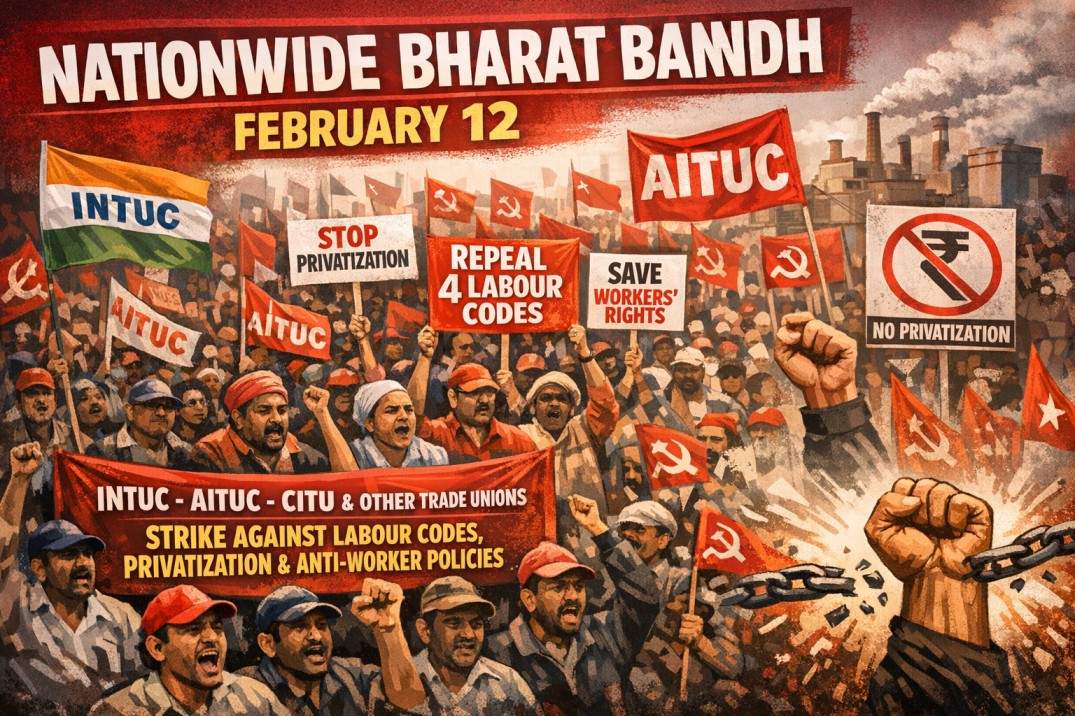
Nationwide Bharat Bandh on February 12, 2026: Trade Unions Call Massive Strike Against Labour Codes and Government Policies
India is bracing for a significant disruption on Thursday, February 12, 2026, as ten major central trade unions have called for a nationwide Bharat Bandh and general strike. This massive protest action, backed by farmers’ organizations and various worker groups, aims to challenge what the unions describe as the central government’s anti-worker, anti-farmer, and pro-corporate policies.
The joint call comes from prominent trade unions: Indian National Trade Union Congress (INTUC), All India Trade Union Congress (AITUC), Hind Mazdoor Sabha (HMS), Centre of Indian Trade Unions (CITU), All India United Trade Union Centre (AIUTUC), Trade Union Coordination Centre (TUCC), Self Employed Women’s Association (SEWA), All India Central Council of Trade Unions (AICCTU), Labour Progressive Federation (LPF), and United Trade Union Congress (UTUC). These organizations, representing millions of workers across sectors, have united in this unprecedented show of solidarity.
Union leaders, including AITUC General Secretary Amarjeet Kaur, have projected that not less than 30 crore workers will participate, surpassing previous mobilizations like the July 9, 2025 strike, which saw around 25 crore participants. The strike is expected to impact over 600 districts nationwide, affecting industries, public services, and daily life in both urban and rural areas.
Core Reasons Behind the Nationwide Bharat Bandh on February 12
At the heart of the protest is strong opposition to the four new labour codes introduced by the central government. These codes—consolidating 29 earlier labour laws—are accused of diluting workers’ fundamental rights. Critics argue that the reforms make it easier for employers to hire and fire workers, reduce protections against unfair dismissals, weaken social security measures, and limit the scope for collective bargaining.
Trade unions claim the labour codes represent a deliberate attempt to favor corporate interests over labour welfare. They are demanding the complete repeal of these codes and a return to more worker-friendly regulations.
Beyond labour reforms, the strike incorporates a broad range of long-standing demands:
- Significant increase in minimum wages to address rising living costs and stagnant incomes.
- Universal social security coverage for all workers, including those in the informal and gig economy.
- An immediate end to contract-based and casual employment practices that deny job security.
- Full reactivation and strengthening of the Mahatma Gandhi National Rural Employment Guarantee Act (MGNREGA) to provide guaranteed rural jobs.
- Legal guarantee of Minimum Support Price (MSP) for farmers to ensure fair returns on agricultural produce.
- Effective measures to control inflation and price rises on essential commodities.
- Complete halt to the privatization of national assets, particularly in strategic sectors like railways, electricity, and public sector undertakings.
The inclusion of farmers’ demands highlights the growing unity between worker and peasant movements. Organizations like the Samyukt Kisan Morcha (SKM) have extended support, linking the protest to broader concerns over agricultural policies and economic liberalization.
Expected Impact: What Will Be Open and Closed on February 12?
The Bharat Bandh call urges a complete shutdown of non-essential activities. Unions have appealed to workers, farmers, students, and the general public to stay home and support the cause.
Potential disruptions include:
- Banks and Financial Services: Public sector banks are likely to see partial or full closures, leading to delays in transactions, cash withdrawals, and other services. Private banks may operate normally in some areas but could face staff shortages.
- Transport: Railways, state-run buses, taxis, autos, and other public transport may be severely affected. Commuters are advised to plan alternative arrangements or avoid travel where possible.
- Government and Private Offices: Central and state government offices, along with many private establishments, could remain closed or function minimally.
- Factories and Industries: Manufacturing units, especially in industrial belts, are expected to see widespread work stoppages.
- Schools, Colleges, and Educational Institutions: Many are likely to declare holidays or face attendance issues.
- Markets and Commercial Establishments: Shops, markets, and businesses may shut down voluntarily or due to lack of workers and customers.
Essential services such as hospitals, emergency medical care, fire services, and water/electricity supply (in critical areas) are expected to remain operational. The actual impact will vary by state, region, and local union strength—stronger in states with high union presence like Kerala, West Bengal, and parts of Assam, while potentially milder in others.
In Assam, local trade unions are actively preparing programs in solidarity, reflecting the nationwide momentum.
Government Response and Broader Context
The Ministry of Labour and Employment has defended the labour codes, stating that they modernize regulations while fully protecting the right to strike—albeit with provisions like a mandatory notice period to maintain industrial harmony.
This strike follows a pattern of growing unrest over economic policies perceived as favoring big business. Previous actions, including the 2025 strikes, have highlighted demands for reversing privatization drives and ensuring equitable growth.
As February 12 approaches, authorities in various states are issuing advisories for citizens to prepare for possible inconveniences. Union leaders emphasize that the Bharat Bandh is a democratic expression of dissent and a call for policy changes that prioritize workers and farmers.
The scale of participation could make this one of the largest coordinated protests in recent years, underscoring deep divisions over India’s labour and economic direction.
Stay tuned for live updates on the February 12 Bharat Bandh, including real-time reports on disruptions, government reactions, and outcomes.