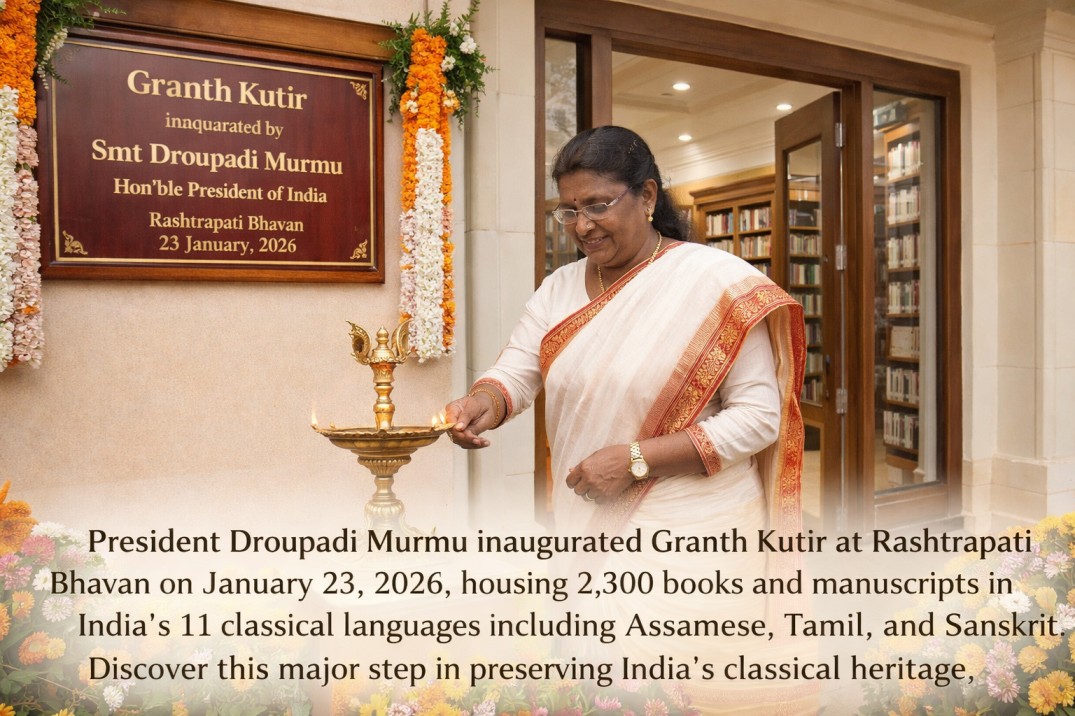
President Droupadi Murmu Inaugurates Granth Kutir at Rashtrapati Bhavan: A Milestone in Preserving India’s Classical Languages and Heritage
New Delhi, January 24, 2026 – In a landmark move to celebrate and safeguard India’s ancient literary and intellectual legacy, President Droupadi Murmu inaugurated Granth Kutir (meaning “Book Cottage” or repository of classical texts) at Rashtrapati Bhavan on Friday, January 23, 2026. This dedicated space now proudly houses nearly 2,300 rare books and manuscripts representing India’s 11 classical languages, marking a significant departure from colonial-era influences and a renewed focus on indigenous knowledge systems.
The inauguration underscores the government’s commitment to preserving classical languages in India and promoting their timeless contributions to global civilization. Granth Kutir stands as a symbol of cultural resurgence, blending traditional wisdom with modern digitization to make these treasures accessible to scholars, students, and the public worldwide.
What is Granth Kutir and Why It Matters
Granth Kutir, located within the historic premises of Rashtrapati Bhavan, serves as a specialized repository showcasing the profound richness of India’s classical heritage. The collection includes works in Tamil, Sanskrit, Kannada, Telugu, Malayalam, Odia, Marathi, Pali, Prakrit, Assamese, and Bengali – the 11 languages officially recognized as classical by the Government of India.
These texts span diverse domains such as epics, philosophy, linguistics, history, governance, science, medicine, yoga, Ayurveda, and devotional literature. Among the highlights are approximately 50 handwritten manuscripts crafted on traditional materials like palm leaves, paper, bark, and cloth. The inclusion of the Constitution of India translated into these classical languages further emphasizes the initiative’s aim to connect ancient roots with modern democratic values.
This project aligns with the broader Gyan Bharatam campaign, a national mission launched by the Ministry of Culture to digitize and preserve India’s vast manuscript heritage. By integrating cutting-edge technology, Granth Kutir ensures that ancient knowledge is not only conserved but also disseminated widely in the digital age.
Shedding Colonial Legacies: A Symbolic Shift
A key aspect of the Granth Kutir initiative is its deliberate effort to move beyond colonial shadows. Previously, parts of the space held colonial-era materials, including catalogues of British artist William Hogarth’s works, speeches by Lord Curzon, administrative reports, biographies, and issues of the famous Punch magazine.
These have now been relocated, digitized, and made available online, freeing the space for authentic Indian classical works. This transition reflects a broader national resolve to prioritize indigenous traditions and reduce the imprint of colonial history in prominent institutions like Rashtrapati Bhavan.
Recognition of New Classical Languages
The timing of the inauguration is particularly significant. In 2024, the Central Government conferred classical language status on Marathi, Pali, Prakrit, Assamese, and Bengali, elevating the total number of classical languages in India to 11. This recognition honors their ancient origins, rich literary traditions, and enduring contributions to philosophy, science, and culture.
The inclusion of Assamese in this prestigious collection is especially noteworthy for communities in Northeast India, highlighting the linguistic diversity that strengthens the nation’s cultural fabric.
President Murmu’s Vision for Classical Languages
During her address at the inauguration ceremony, President Droupadi Murmu emphasized the foundational role of classical languages in shaping Indian culture and influencing the world. She noted that these languages have guided humanity through advancements in science, yoga, Ayurveda, literature, and more.
The President specifically referenced landmark contributions such as:
- The Tirukkural (Tamil ethical literature)
- Arthashastra (ancient treatise on statecraft and economics)
- Panini’s grammar (foundational Sanskrit linguistics)
- Aryabhata’s mathematical and astronomical works
- The medical sciences of Charaka and Sushruta
She urged universities to incorporate classical language education into curricula, encouraged the youth to learn at least one classical language, and advocated for greater availability of these texts in libraries and online platforms.
Access and Collaboration
Visitors to Rashtrapati Bhavan can now view selected works from Granth Kutir in person. For wider reach, a dedicated online portal provides digital access to the digitized books and manuscripts. Researchers and scholars can apply through this portal for physical or detailed access.
The project is a collaborative triumph, involving central and state governments, universities, research institutions, cultural bodies, private donors, and expert support from the Indira Gandhi National Centre for the Arts (IGNCA) under the Ministry of Education and Culture.
A New Chapter for India’s Ancient Knowledge
Granth Kutir represents more than a library – it is a beacon for future generations to reconnect with India’s unparalleled intellectual legacy. By preserving and promoting classical languages in India and their associated manuscripts, the initiative ensures that ancient insights in science, philosophy, governance, and spirituality continue to inspire and guide the world.
This inauguration is a proud moment for cultural revival, digitization of heritage, and national identity. As India steps forward in preserving its past while embracing the future, Granth Kutir stands as a testament to the enduring power of knowledge rooted in diversity and tradition.